RentSafe
Towards healthy homes for all: What the RentSafe findings mean for public health in Canada
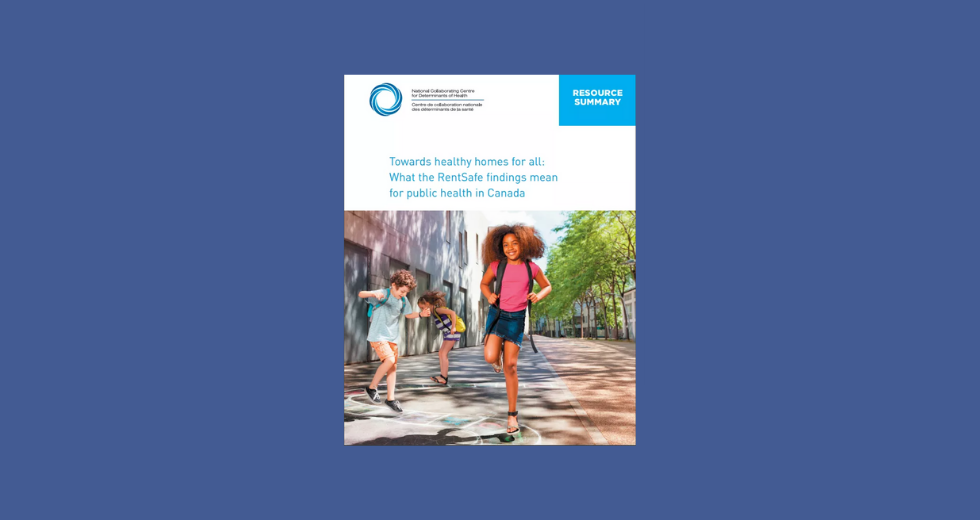
Housing is considered to be a core social determinant of health (SDH) and intersects with a number of other SDH — including food insecurity and inadequate income — to create population health inequities. While housing is considered important to health outcomes, it may not be clear to public health practitioners if action on unhealthy housing as part of social and built environments is part of their scope or role.
Read more:
Download the summary document

Welcome to RentSafe

CPCHE is leading an ambitious initiative to address unhealthy housing conditions affecting tenants living on low income in both urban and rural communities in Ontario. With active involvement of public health, legal aid clinics, community health and other stakeholder organizations as well as tenants and housing providers, we aim to build awareness and capacity across multiple sectors so that low-income tenants, when faced with lead, mould, radon and other indoor health threats, are better able to get the support they need to achieve healthier living conditions for themselves and their families.This 3-year initiative, launched in December 2014, is funded by the Ontario Trillium Foundation and supported by in-kind contributions and involvement of multiple partners.
Following are documents and selected CPCHE publications relevant to RentSafe:
- RentSafe EquIP in Owen Sound, ON – Project Overview
October 2018
Fact Sheet - Toward Healthy Homes for All: RentSafe Summary and Recommendations
April 2018
Report - RentSafe Connector, Step-by-step guide
2018
Tip card - RentSafe Survey of Small-Scale Landlords: Summary Report
April 2018
Report - Frontline Connections: Supporting Tenants’ Rights to Healthy Housing – A RentSafe video
2018
Video - RentSafe Tenant Advocates Retreat Summary
2018
Report - RentSafe Update (June 2017)
June 2017
Summary - RentSafe Roundtable Summary Report
May 2017
Minutes - RentSafe Survey of Small-Scale Landlords: Poster presentation
March 29, 2017
Poster - Stigma in the System
2017
Video - Defining Adequate
2017
Video - My Voice is Power
2017
Video - RentSafe Roundtable presentations
November 23, 2016
Presentation - RentSafe whiteboard video “Home”
2016
Video - RentSafe Roundtable Discussion Paper: What we have learned so far about the experiences of and responses to unhealthy housing conditions
November 2016
Report - RentSafe Advisory Committee
May 2016
Background information - RentSafe Update (April 2016)
April 2016
Summary - RentSafe Panel Session at The Ontario Public Health Convention (TOPHC)
April 5, 2016
Presentation - RentSafe Legal Aid Survey – Summary Report
February 2016
Report - RentSafe Public Health Unit Survey: Summary Report
November 2015
Report - RentSafe Background Paper on Housing-related Health Risks
October 2015
Report - RentSafe Project Overview
January 2015
Summary - Home Safety for your KIDS’ sake mini-poster
February 12, 2014
Mini-poster - Creating Healthy Environments for Kids
June 2011
Brochure - Healthy Retrofits: The Case for Better Integration of Children’s Environmental Health Protection into Energy Efficiency Programs
March 2011
Report
The following FAQs address some of the housing-related health risks that are the focus of the RentSafe initiative:
Should I be testing for radon levels in my home?
What are the safest products to use when I am repairing or renovating my home?
We found mould during our renovations. What should we do?
If I find that my home has high levels of radon, how much will it cost to fix it?