RentSafe
Toward a safe and healthy place to call home: Summary of a survey of public health practices on healthy rental housing in Ontario

Authors: RentSafe, National Collaborating Centre for Determinants of Health, & Ontario Public Health Association
Published: November 2025
Cette ressource est également disponible en français.
This resource is intended to support public health practitioners, policymakers and actors from other sectors to promote healthy housing through intersectoral collaboration and equity-focused approaches. It highlights key concepts related to the impact of housing conditions on health and examples of promising practices by Public Health Units (PHUs) in Ontario. It is intended to inform and catalyze preventive and proactive responses to housing inadequacy and habitability concerns across public health and other sectors in the housing system.
Healthy housing provides the foundation for health and well-being
For too many tenants in Canada, their housing jeopardizes their health and well-being. Conditions such as mould, deteriorating lead paint, inadequate heat and cooling, pests, frequent pesticide usage, and poor indoor air quality take a heavy toll on the health and well-being of residents. This is especially true for those already facing systemic barriers associated with housing access and affordability as well as disability, race/ethnicity, Indigeneity, gender, and/or newcomer status.
Despite the direct links between healthy housing and population health, specific roles for public health to intervene in rental housing conditions remain underexamined. More leadership and greater capacity are needed in public health and other sectors for real and sustained action.
That’s why RentSafe and the Ontario Public Health Association conducted a survey of public health units in Ontario in the winter of 2023–2024. The purpose of the survey was to identify relevant public health practices and opportunities for action. This report, produced in collaboration with the National Collaborating Centre for Determinants of Health, presents our findings and recommendations.
For a full summary of the survey data, please access the RentSafe-OPHA Survey Results Report.
Public health is well positioned to promote healthy rental housing
The report analysis identifies five core public health roles and opportunities to address inadequate and unhealthy housing conditions as a determinant of health and key driver of health inequity. Ideas for where to start and bright spot examples from the field accompany each area for action. The areas identified include:
- Engage grounded expertise to integrate the knowledge, insights, perspectives, skills and leadership of people with lived and living experience
- Partner with other sectors to engage with health and non-health sectors to co-develop and implement strategies
- Assess and report community-based data and knowledge on the existence and impact of unhealthy housing conditions
- Modify and orient interventions to promote healthy housing conditions and reduce associated inequities
- Participate in policy development by sharing leadership and providing support to tenant groups and housing organizations for analysis and advocacy
A few ways to use this report:
- Build a case for why and how improving rental housing conditions is a public health priority to advance health equity
- Develop a plan for engaging grounded expertise in all public health housing-related strategies
- Identify intersectoral partners in your area for relationship development and collaborative action on housing conditions
- Share examples of real-time public health actions as a model to adapt for your own work
Related Resources
New RentSafe Project Announcement: Collaborating for Climate Resilience in Low-Income Rental Housing

A healthy home provides the foundation for health and well-being. Renters with low incomes disproportionately experience an increased burden of health inequities due to poor housing conditions, lack of housing availability and affordability, and disproportionate exposure to the risks of climate change. RentSafe, an initiative of the Canadian Partnership for Children’s Health and Environment (CPCHE), aims to address unhealthy housing conditions affecting renters by building awareness and capacity across sectors so that renters, when faced with unhealthy housing conditions, are better able to get the support they need. RentSafe aims to build proactive and collaborative systems that ensure renters have access to adequate housing, a critical step in increasing health equity and climate resilience.
RentSafe, together with the Canadian Environmental Law Association (CELA) as lead partner, is excited to announce our new funding from the Public Health Agency of Canada’s Intersectoral Action Fund to mobilize intersectoral strategies for climate resilience in low-income rental housing.
Over the next two years, RentSafe, CPCHE, and CELA are eager to work with our partners from across sectors to build on our existing work and expertise to act on several strategic opportunities that will support communities across Ontario to improve climate resiliency in low-income rental housing and advance health equity. The project will mobilize RentSafe’s established collaboration among public health, municipal services, legal aid, social services, other relevant sectors and the grounded expertise (lived and living experience) of tenants and housing providers, to build capacity and address the overlapping concerns of inadequate housing conditions, climate change, and environmental injustice including: extreme weather events (e.g. heat, flooding/mould), degraded indoor air quality due to wildfires and other sources of pollution, and cumulative health risks borne by under-resourced communities due to disproportionate exposures to the effects of climate change.
To accomplish the aims of this project, the project activities will include:
- convening intersectoral roundtables to understand the opportunities and barriers;
- assessing promising model maximum heat by-laws and their implementation;
- developing a toolkit to identify promising practices and solutions to common barriers to climate action in rental housing; and
- coordinating a collective call for action, supporting and leveraging our networks.
By fostering collaboration and improved regulation, such as local by-laws, this project expands upon RentSafe’s decade-long efforts to strengthen intersectoral approaches that improve prevention, remediation, reduction of exposures, and responses to conditions in low-income rental housing that threaten tenants’ health and wellbeing. The project will also further integrate community climate resilience into our ongoing work at all levels, including our community-level work with the RentSafe Owen Sound Collaborative. This project recognizes the ability of climate change to exacerbate existing inequities and the opportunity to realize the multiple benefits of climate action in rental housing.
We look forward to collaborating with our partners to advance equity-oriented housing-based climate strategies in communities across Ontario. Reach out to Geri Blinick at geri@healthyenvironmentforkids.ca to learn more about the project and join our collaboration.
Webinar Recording: Addressing unhealthy conditions in rental housing: the case of mould
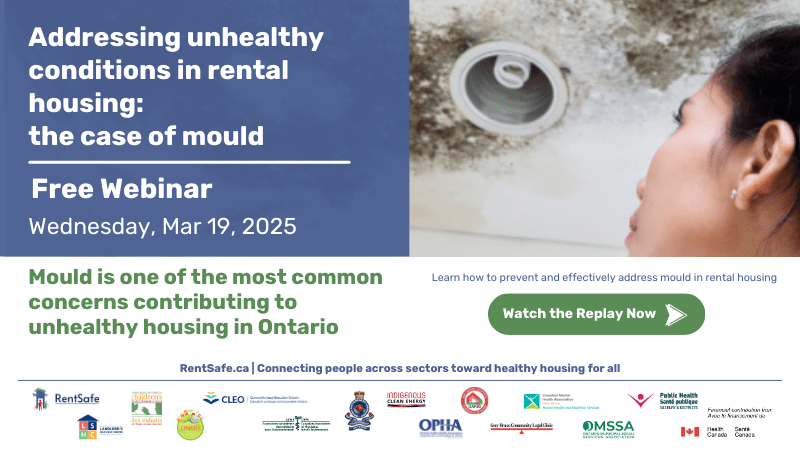
RentSafe is pleased to partner with CLEO on this interactive learning session to gain practical tips and resources to prevent and address mould and improve conditions in rental housing.
This webinar offers tenants, landlords, public health, health care and social service providers information to increase their understanding of mould and its health effects and offer legal considerations including landlord and tenant rights and responsibilities.
Speakers:
- Dr. Donald Cole, MD FCFP(C), Canadian Association of Physicians for the Environment, Environmental, Occupational and Public Health Medicine Consultant
- James Kemp, Accessibility Committee for Person with Disabilities for the City of Hamilton, Chair
- Chad Bonnetrouge, Indigenous Clean Energy, Energy Efficiency Program Coordinator
- Katherine Wauthier, Landlord Self-Help Centre, Paralegal/Community Legal Worker
- Seana Moorhead, Grey-Bruce Community Legal Clinic, Lawyer/Executive Director
- Alexander Wray, Ontario Association of Property Standards Officers, President
- Michael Foster, Ontario Association of Property Standards Officers, Board member
- Helen Doyle, Ontario Public Health Association, Chair of Environmental Health Work Group
- Marivi Barrios. RentSafe, Environmental Health Specialist
- Burgess Hawkins, Public Health Sudbury and Districts, Manager, Environmental Health
- Darryl Wolk, Ontario Municipal Social Services Association, Manager, Policy Development & Public Affairs
- Scott McKay, CMHA Grey Bruce Mental Health and Addictions Services, Director of Client Services
- Rebecca Carr, CMHA Grey Bruce Mental Health and Addictions Services, Manager of Housing
- Erica Phipps, Canadian Partnership for Children’s Health and Environment, Executive Director